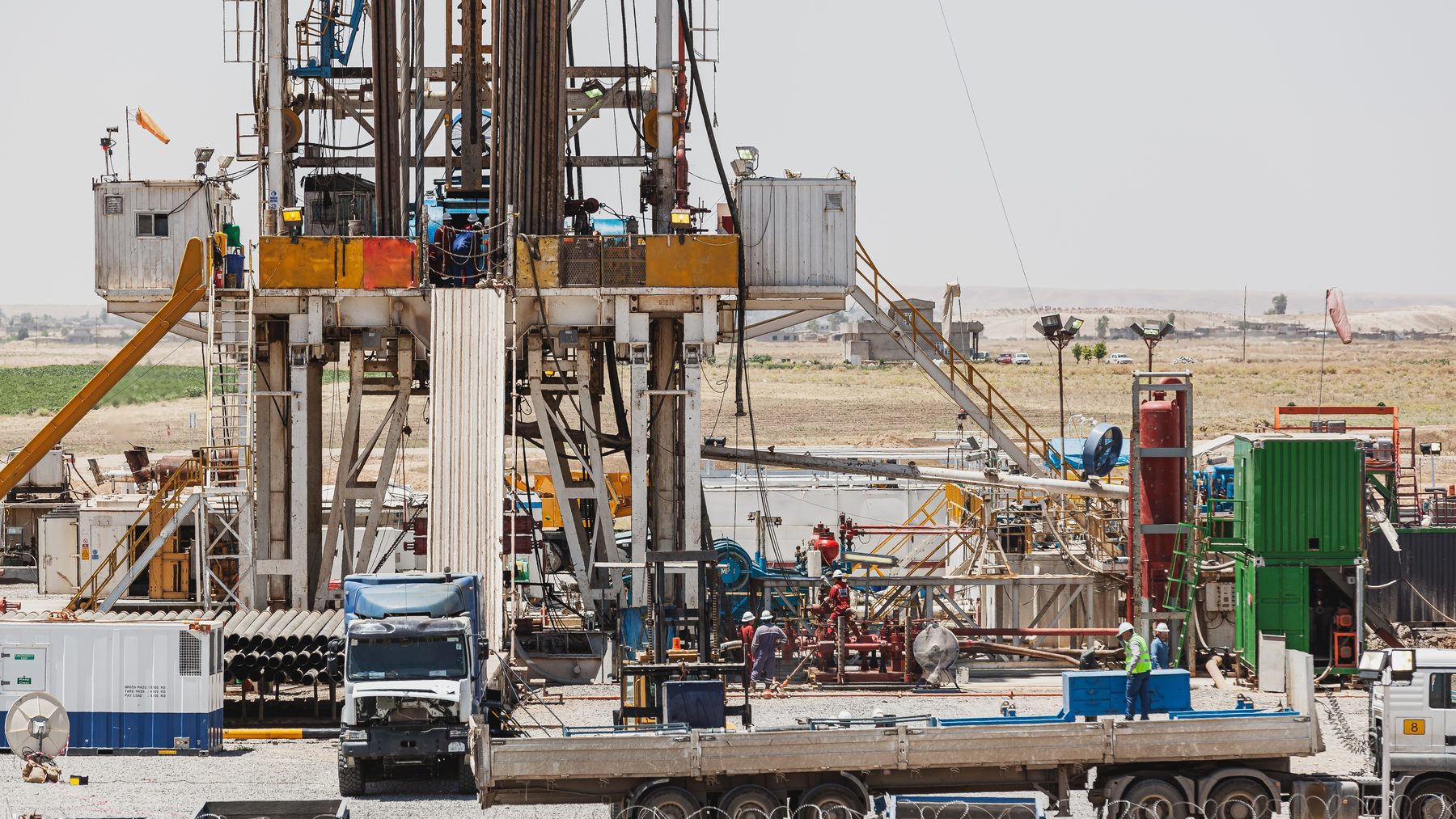
Vaca Muerta now produces 670 thousand barrels of oil per day. It is the number repeated in every announcement, every conference and every headline. But there is another, less quoted number that explains how it is sustained: 52% of that oil comes from wells less than a year old.
To sustain that number you have to keep running: drilling, fracturing and hooking up new wells all the time, and bringing in, truck after truck, the sand needed to replace the wells that have already started to decline.
The treadmill that never stops
In August 2026 there were 2,890 producing wells in Vaca Muerta. Those that came on production in the last twelve months (521, of which 511 are still active) contribute 348 thousand barrels per day. The 1,005 wells older than five years, twice as many wells, contribute 50 thousand.
That is the nature of shale. A Vaca Muerta well loses more than half of its production in the first year, a third in the second, and then keeps declining more slowly. Measured by what each group of wells did between August 2025 and August 2026: those under one year retained 47% of their production, those one to two years old 67%, and those two to three years old 74%.
If drilling and fracking stopped tomorrow, Vaca Muerta oil production would fall 39% in twelve months: from 670 thousand to about 410 thousand barrels per day. And since conventional fields are also declining, about 10% a year, the country's oil production would fall 31%: from about 930 thousand to 640 thousand barrels per day. In two years, the drop would reach 44%. It is like running on a treadmill: to stay in the same place you have to keep running, and the faster the treadmill goes, the more you have to run.
Three targets, three calculations
For the calculation we start from a simple assumption: each group of wells declines as it did over the last year, and a new well performs like those that came on in the last year (an average of 668 barrels per day in August). A Vaca Muerta well today takes about 52 frac stages and about 11,900 tons of sand. Conventional production, which still contributes about 260 thousand barrels per day, declines 10.5% per year.
Target 1: Vaca Muerta does not fall. About 260 thousand barrels per day must be replaced in a year. That means 391 wells to drill, frac and hook up between September 2026 and August 2027: more than one per day. About 20,300 stages and 4.7 million tons of sand.
Target 2: the country does not fall. Here we ask Vaca Muerta to also take on the decline of conventional production, about 27 thousand barrels per day per year. That means 432 wells, 22,400 stages and 5.1 million tons of sand.
Target 3: the country adds 100 thousand barrels per day every year. That means 581 wells over the next twelve months, 30,200 stages and 6.9 million tons of sand.
To put it in perspective: in the last twelve months 521 Vaca Muerta wells came on production, and with that the country grew by about 110 thousand barrels per day. Next year, to grow by the same amount, 60 more wells are needed. The treadmill keeps going faster.
And if the target is to grow 100 thousand barrels per day every year, the math grows on its own, because each year there is more young oil to sustain:
| Year | Wells | Etapas | Sand (million t) | Trucks per day | Country (bbl/d) |
|---|---|---|---|---|---|
| 2027 | 581 | 30.200 | 6,9 | 630 | 1.03 million |
| 2028 | 636 | 33.100 | 7,6 | 690 | 1.13 million |
| 2029 | 685 | 35.600 | 8,2 | 745 | 1.23 million |
| 2030 | 730 | 38.000 | 8,7 | 795 | 1.33 million |
That is 31 million tons of sand over four years, with wells identical to today's. The trucks assume 30 tons per trip, every day of the year. And that is only the sand: each stage also takes water, chemicals, hours of frac spread, wireline, coiled tubing, plugs and flowback.
Each ton yields less
Here comes the second problem. Not only does more sand have to be brought in each year: each ton of sand yields less oil.
Between 2018 and 2022, a Vaca Muerta horizontal oil well produced in its first year between 27 and 29 barrels for every ton of sand pumped. Then it began to fall: 23.7 in 2023, 21.7 in 2024 and 21.0 for wells that started in 2025. That is 25% less than four years ago.
The explanation lies in the median well. Since 2021, sand per well went from 8,300 to 11,800 tons (+42%), stages from 37 to 50, and the lateral kept getting longer. First-twelve-month oil stayed stuck at about 240 thousand barrels. Each new stage adds less than the previous one: diminishing returns.
And the newest wells? Those that started in the second half of 2025 do not yet have a year, so we compare them at six months: 13.4 barrels per ton, versus 17.6 for those that started in the second half of 2021. Somewhat better than those of 2024 (12.0), but far from earlier levels.
Is gas to blame?
A reasonable hypothesis is that sand yields less oil because development has shifted toward the volatile oil window, closer to gas. In that area each well produces more gas per barrel, and part of the sand's work would go into gas.
The Energy Secretariat data say that this explains little. We classified each oil well by its first-year gas-oil ratio (the McCain cutoffs: up to 312 m³ of gas per m³ of oil is black oil, from 312 to 570 is volatile):
- The median gas-oil ratio of oil wells did not rise: 129 m³/m³ in 2021, 112 in 2025.
- Wells in the volatile oil window went from 7% to 10% of the total. A shift, but a small one.
- The decline shows up equally within the purest black oil: in wells under 150 m³/m³, yield fell from 27.8 to 20.1 barrels per ton between 2021 and 2025.
- Counting gas as barrels of oil equivalent, yield also falls: from 33 to 24 barrels of oil equivalent per ton. Gas does not compensate.
| Window (wells of 2025) | Wells | Sand per well (t) | Oil 12 months | bbl per ton | boe per ton |
|---|---|---|---|---|---|
| Black oil | 239 | 11.900 | 239 thousand bbl | 20,5 | 23,0 |
| Volatile oil | 28 | 11.600 | 279 thousand bbl | 24,5 | 33,5 |
Paradoxically, in 2025 volatile oil wells yielded more per ton than black oil wells, in oil as well. There are few wells and they should be viewed with care, but the conclusion is clear: the loss of sand efficiency does not come from shifting toward gas. It comes from increasingly intensive wells that do not produce more.
What it means
For operators, that cost per barrel depends more and more on sand logistics and the frac spread, and less on the rock. For the country, that growing 100 thousand barrels per day per year requires going from the 5 million tons of sand reported in the last twelve months (more than 6 once the wells missing from the registry are completed) to 7 in 2027 and almost 9 in 2030, with wells identical to today's. If sand per well keeps rising at the pace of the last four years, in 2030 it would be more than 12 million.
For suppliers, that demand is assured as long as the price holds: the treadmill cannot be stopped without the country's production falling by almost a third in a year. Sand, transport, water, frac spreads, well hook-up and facilities are not an activity peak: they are the cost of staying in place.
And for everyone, a question: if each ton yields less, the next improvement will not come from pumping more, but from pumping better. Lateral spacing, stage design, local sand closer to the wells, trains and fewer truck miles. Whoever solves it will be able to run just as fast while spending less.
How we did the math
Energy Secretariat data: monthly production by unconventional well through August 2026 (Vaca Muerta formation) and fracturing data from Attachment IV (domestic and imported sand, stages, lateral). Age: months since the first month with production. Decline: what each group of wells retained between June-August 2025 and June-August 2026 (for those over five years, capped at 5% per year in the projection to 2030). Efficiency: horizontal oil wells with reported fracturing, cumulative oil of the first 12 (or 6) months over sand pumped. Attachment IV does not yet have all the fracs (in 2025 it covers about 92% of shale stages), so sand totals are calculated using sand per well and not the reported sum. Conventional: total national production minus unconventional, April-June 2026 versus 2025. These are faufena estimates, not forecasts.
Keep reading
- Fracs in Vaca Muerta, month by month and by field
- Completion: hydraulic fracturing and frac sand · Freight logistics and transport · Well hook-up
- Frac sand companies on faufena: Delta Arenas, Grupo Masur, San Benito Energía
Lautaro Maggi · Chemical Engineer (ITBA) · Specialist in Oil and Natural Gas Production (ITBA)
About faufena
faufena is an online catalog of companies in the Oil & Gas, energy, mining and renewables sectors of Argentina. There you can find suppliers and potential customers, as well as sector information and analysis, like this article. Visit faufena.com.